
WhatsApp Automation for Manufacturing Companies
April 19, 2026

Why Your Manufacturing Website Is Not Generating Export Leads (And How to Fix Each Problem)
You have a website. It looks reasonable. You might even be paying someone to ‘do SEO’ for it. And yet, the export inquiries are not coming. You are still depending on trade fairs twice a year and word-of-mouth referrals from existing clients. Every now and then someone fills out the contact form — but they are rarely the international buyers you are trying to reach.
This is one of the most common situations we encounter when auditing manufacturing websites in Pune’s MIDC areas. The website exists, but it is not working as a sales tool. In almost every case, the problem is not random — it is one or more of a specific set of identifiable, fixable issues.
Here are the seven reasons manufacturing websites fail to generate export leads, with specific fixes for each. Reason 1: Your Website Has No SEO Architecture — Google Cannot Find Your Products The most common and most damaging issue. A manufacturing website built without keyword research is invisible to Google for the search terms international buyers actually use. A web designer creates a beautiful homepage, a products page listing all your products in one place, a gallery, and a contact page. This is not an SEO architecture. It is a digital brochure.
International buyers do not search for ‘[Your Company Name]’ — they search for specific products: ‘brake pad manufacturer India’, ‘IATF certified auto components supplier’, ‘precision CNC parts manufacturer Pune.’ If each of those searches does not have a dedicated, optimised page on your website, Google has nothing to rank and buyers have nothing to find.
The fix: Create a separate SEO-optimised page for each major product category. Each page should have: a keyword-targeted H1 (e.g., ‘Brake Pad Manufacturer in India — OEM Quality, Export Ready’), a 400-600 word description of the product including technical specifications, applicable standards, material grades, and export experience, your relevant certifications displayed prominently, and a clear inquiry CTA. For a manufacturer with 8 product categories, this means 8 product pages with proper SEO — not one generic ‘Products’ page. TIP Keyword research for a manufacturing website should always include product name + 'manufacturer India' patterns, product name + certification patterns (IATF, ISO, GMP), and product name + target country patterns. These are the search terms used by buyers in active sourcing mode. Reason 2: Your Website Loads Too Slowly — Especially on Mobile International buyers evaluating suppliers frequently use mobile devices. If your website takes more than 3 seconds to load on a mobile phone, 53% of those visitors leave before seeing any content. Google also uses page speed as a direct ranking signal — slow websites rank lower than fast ones for identical content.
Manufacturing websites are particularly prone to speed problems because they often contain large, uncompressed product images, multiple heavy JavaScript libraries, and hosting on cheap shared servers with slow response times.
The fix: Test your website at PageSpeed Insights (pagespeed.web.dev) right now. If your mobile score is below 70, you have a problem affecting both rankings and conversion. The most impactful fixes are: convert all images to WebP format and compress them, move hosting to a cloud server (AWS or DigitalOcean) with a CDN, and remove or defer JavaScript that is not essential for the initial page load. A well-optimised manufacturing website should score 85+ on mobile PageSpeed. STAT A 1-second improvement in page load time increases conversion rate by 7%. For a manufacturing website receiving 200 qualified monthly visitors, improving from a 5-second to a 2-second load time can mean 8-12 additional inquiries per month from the same traffic. Reason 3: Your Website Has No Regulatory or Certification Information International buyers — especially from UAE, EU, and USA markets — eliminate suppliers from their shortlist within 30 seconds if the website does not clearly display quality certifications and regulatory compliance. This is the primary trust signal they are evaluating in the first pass.
A website that shows an ISO logo in the footer is not the same as a website that has a dedicated Certifications & Compliance page showing the actual certificate, the certifying body, the certificate number, the scope of certification, and the validity date. The difference in buyer confidence between these two approaches is substantial.
The fix: Create a dedicated Quality and Certifications page listing every certification your facility holds: ISO 9001, IATF 16949, WHO-GMP, CE marking, FDA registration, NABL accreditation, or whatever is relevant to your product category. Include the certificate number, issuing body, scope, and expiry date. Make the certificate available for download if it is public. Add your named Quality Manager or Regulatory Affairs contact on this page with direct contact details. This single page change has a measurable impact on international buyer inquiry rates. Reason 4: Your Product Pages Have No Technical Specifications A manufacturing buyer assessing you as a potential supplier needs technical information to make a sourcing decision. Material grades, dimensional ranges, tolerance capabilities, surface treatment options, applicable standards, packaging formats, and MOQ. If this information is not on your website, the buyer has to email or call to get basics — and most international buyers simply move on to the next supplier who provides the information upfront.
The fix: Add a technical specifications section to every product page. Format it as a structured table: material specifications, dimensional range, tolerance capability, surface treatment options, applicable standards (IS, DIN, ASTM, JIS, etc.), standard packaging, and available certifications for that specific product. This content also serves double duty as SEO content — technical specification searches are among the most specific and highest-intent searches industrial buyers make. Reason 5: Your Inquiry Process Is Too Complicated or Asks for Too Little Manufacturing websites fail at inquiry conversion in two opposite ways: the form asks for too much (20-field forms that feel like a government application), or the form asks for too little (just name, email, and message — which generates vague, unqualified inquiries that take 4 more emails to qualify).
The right inquiry form for a manufacturing website collects exactly the information your sales team needs to provide a meaningful first response: product or product category, approximate quantity required, delivery destination country, timeline, and contact details. Five to seven fields, specific to the manufacturing buyer’s typical inquiry, with a clear promise of response time.
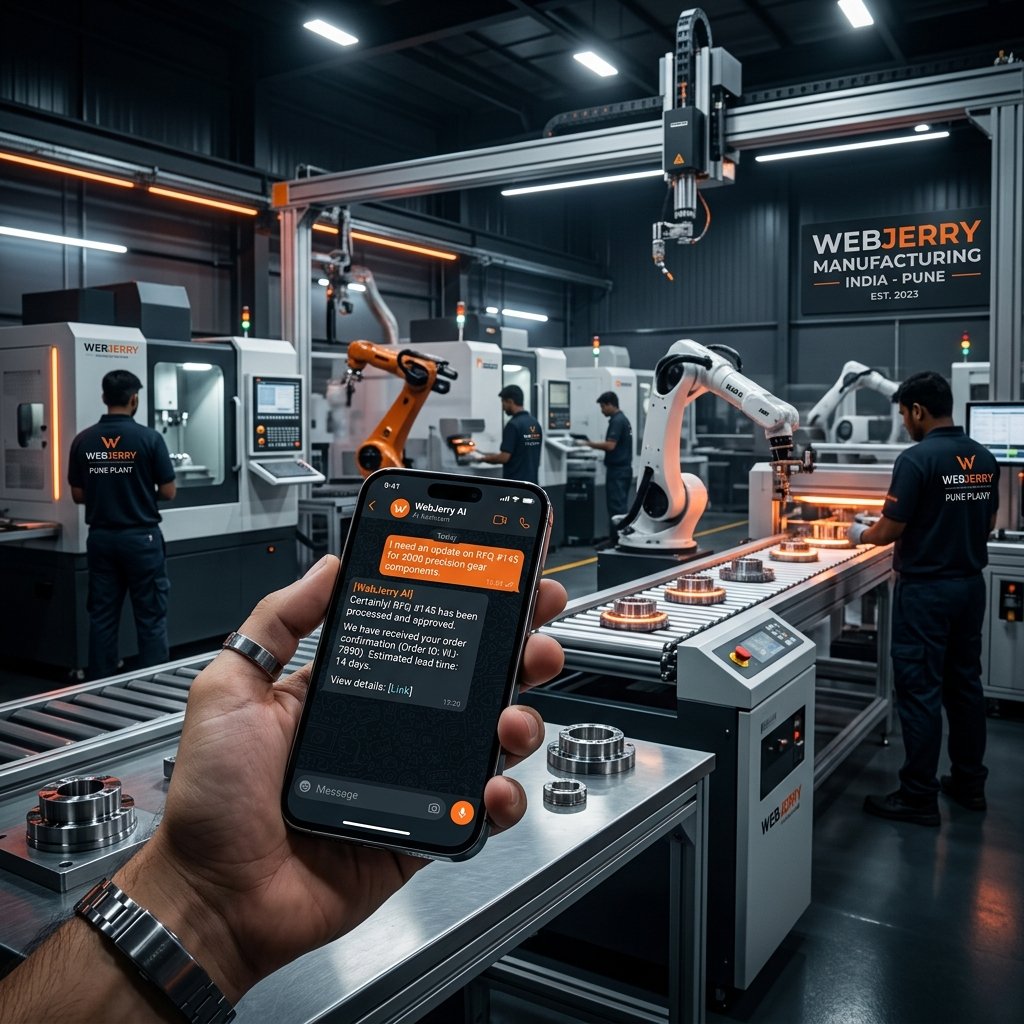
The fix: Replace your generic contact form with a structured RFQ form: product (dropdown of your categories), quantity required (text field), delivery country (dropdown), timeline (select: immediate / 30 days / 60 days / 90+ days), company name, name, email, and WhatsApp number. Add a visible response time commitment: ‘Our team will respond within 4 business hours.’ This one change typically increases inquiry-to-quotation conversion by 30-50%. NOTE Also add a WhatsApp click-to-chat button on every product page and in the header. For UAE, South Asian, and African buyers, WhatsApp is often the preferred channel for first contact. A website without WhatsApp integration is losing inquiries from these markets. Reason 6: Your Website Has No Export-Specific Content A website that talks only about domestic supply capabilities is invisible to export buyers. International procurement teams search for suppliers using export-specific language: ‘export to UAE’, ‘supply to GCC countries’, ‘India to Germany supplier.’ If your website has no content addressing export markets, your Google ranking for these searches is zero.
The fix: Add an Export page or Export section to your website that specifically addresses your international supply capability. Include: the countries you currently export to, any international certifications relevant to those markets (EU-GMP for Europe, FDA for USA, GCC registration for Gulf), your export documentation capability (COO, FORM-E, EUR1), your logistics partners, and any reference to export track record. For priority export markets, consider creating dedicated landing pages: ‘Auto Components Supplier for UAE Market’ or ‘Precision Parts Manufacturer — Export to Germany.’ Reason 7: You Have No Google Business Profile or It Is Incomplete Google Business Profile (GBP) is a massively underused asset for manufacturing companies. Even for a B2B manufacturer not targeting walk-in customers, a well-optimised GBP provides a significant credibility signal to Google and dramatically improves your appearance in local + sector searches.
International buyers who find your website often then search for your company name to validate you — looking for reviews, photos, operating hours, and a verified business presence. A missing or incomplete GBP is a trust gap that costs you inquiries at the validation stage.
The fix: Claim and fully complete your Google Business Profile. Add: accurate address and phone number, business hours, all product categories you manufacture, 10+ high-quality photos of your facility and products, a description that includes your key products and export markets, and a strategy for collecting Google reviews from domestic clients. Weekly GBP posts about your manufacturing activity, certifications, and export milestones also contribute to better local search visibility. The Audit Checklist: Score Your Website Right Now Before investing in any digital marketing, run your manufacturing website through this 7-point audit. Every ‘No’ answer is a lead generation problem you can fix:
• Does Google index a separate page for each of your major product categories? (Check: site:yourwebsite.com in Google search) • Does your website score 80+ on Google PageSpeed Insights for mobile? (Check: pagespeed.web.dev) • Do you have a dedicated page displaying all your certifications with certificate numbers and validity dates? • Do your product pages include a technical specifications table with material grades, tolerances, and applicable standards? • Does your RFQ/inquiry form collect product, quantity, destination country, and timeline — not just name and email? • Does your website have an Export page or export-specific content addressing your international supply capability? • Is your Google Business Profile claimed, complete, and updated in the last 30 days?
April 19, 2026

April 19, 2026
April 19, 2026
Pune, India