WhatsApp Automation for Manufacturing Companies
April 19, 2026
AI Voice Bot vs Human Receptionist: The Honest Cost Comparison for Indian Businesses in 2026
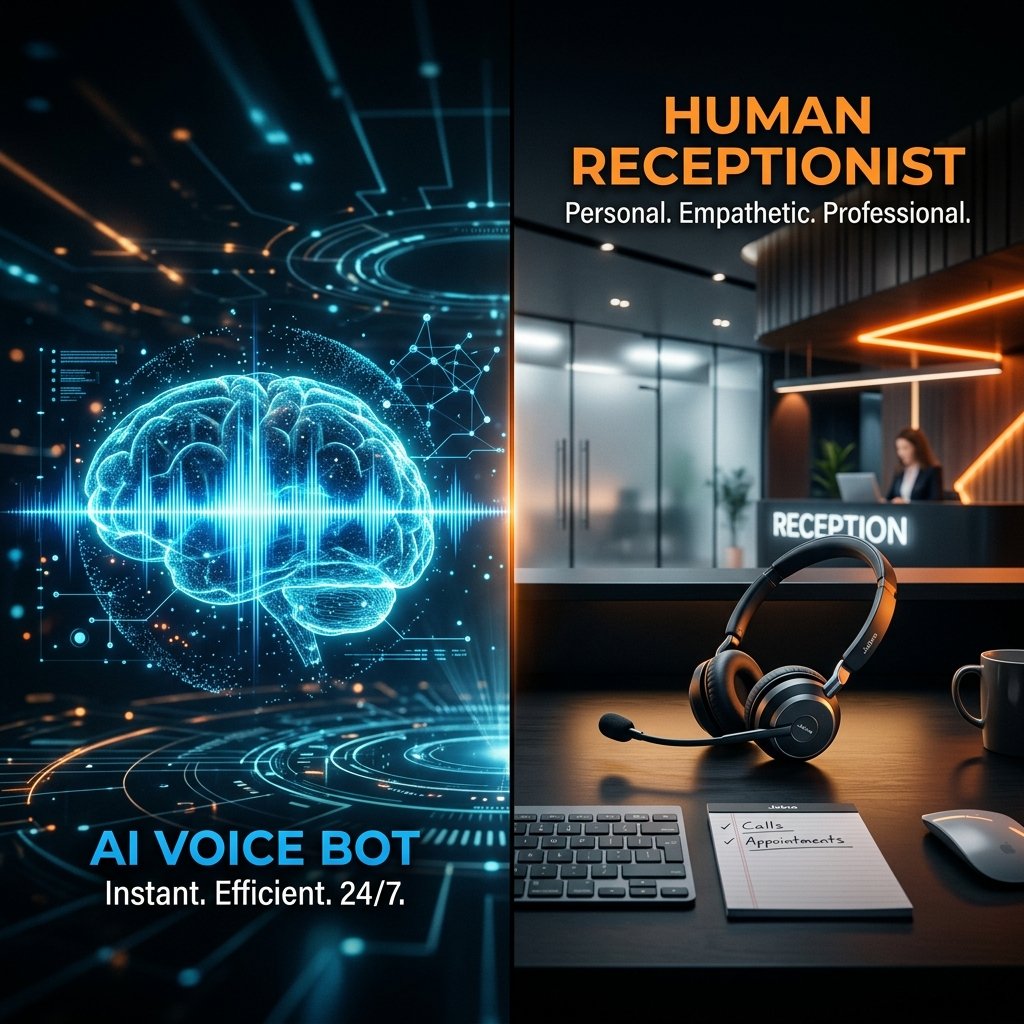
When business owners first hear about AI voice bots, the immediate reaction is often the same: “That must be expensive. We can just hire a receptionist.” It is a completely reasonable assumption. And it is wrong — consistently, measurably, and sometimes dramatically wrong.
This article does something most AI vendors will not do: it puts the real numbers on the table for both options, covers the genuine limitations of each, and gives you a framework for deciding which one — or which combination — makes sense for your specific business. The True Cost of a Human Receptionist in India When business owners calculate the cost of a human receptionist, they usually think of the gross salary. But the actual cost is significantly higher. Here is the complete picture for a receptionist in a Pune business in 2026:
Cost Component Monthly Amount Gross salary (entry-level receptionist, Pune) ₹18,000 – ₹28,000 Employer PF contribution (12% of basic) ₹1,440 – ₹2,160 Employer ESI contribution (3.25% of gross) ₹585 – ₹910 Gratuity provision (4.81% of basic) ₹576 – ₹865 Recruitment cost amortised (₹15,000 avg, 18-mo tenure) ₹833 Training time cost (first 4-6 weeks productivity loss) ₹2,000 – ₹4,000 Leave coverage cost (8-12 days annual leave + sick leave) ₹1,200 – ₹2,800 TOTAL TRUE MONTHLY COST ₹24,634 – ₹39,568
The number most business owners quote — ₹18,000-28,000 — is just the salary. The true cost of employing a receptionist in India is closer to ₹25,000-40,000 per month when you factor in statutory contributions, recruitment, training, and leave coverage.
And that cost buys you availability during business hours only. Typically 9am to 6pm, Monday to Saturday. Public holidays: zero coverage. Peak call periods: hold times and missed calls. After 6pm: voicemail or unanswered rings. STAT A full-time receptionist provides approximately 2,340 hours of call-handling coverage per year (9 hours/day × 260 working days). Your business has 8,760 hours in a year. A human receptionist covers 27% of them. The True Cost of an AI Voice Bot in India An AI voice bot from a provider like WebJerry Technologies is priced in two parts: a one-time setup fee covering development, training, and deployment, and a monthly maintenance fee covering server infrastructure, AI processing costs, and ongoing support.
Cost Component Amount Setup fee (Starter package — English, basic lead capture, CRM integration) From ₹59,999 one-time Monthly maintenance fee (Starter — up to 500 calls/month) ₹14,999/month Amortised setup over 36 months (3-year horizon) ₹1,667/month TOTAL MONTHLY COST (Starter, 3-year horizon) ₹16,666/month
That is ₹16,666 per month for 24/7/365 call coverage with no sick leave, no public holidays, no hold times, and zero unanswered calls. Compared to ₹25,000-40,000 per month for a human receptionist who covers 27% of your available hours.
Over a 3-year horizon, the financial case for an AI voice bot for call-heavy businesses is straightforward. But cost is only part of the comparison. The Capability Comparison: What Each Option Does and Does Not Do Beyond cost, the more important question is: what does each option actually do well, and where does each fall short?
Capability Human Receptionist AI Voice Bot Availability 8-10 hrs/day, 6 days/week 24 hours, 365 days Response time Instant (if not on another call) Under 2 seconds, always Simultaneous call handling 1 call at a time Unlimited calls simultaneously Consistency of quality Varies by mood, fatigue, training 100% consistent, every call Language flexibility Typically 1-2 languages English, Hindi, Marathi, Arabic and more CRM data entry Manual, often delayed or incomplete Automatic, real-time, structured Handling upset or abusive callers Can de-escalate, empathise, judge Consistent but cannot match human empathy Handling complex, unusual queries Strong — can improvise and problem-solve Limited to trained responses; escalates unknown queries Building long-term caller relationships Strong for regular clients who know the person Limited — each call is stateless without memory design Scalability Linear cost increase per agent Zero marginal cost for additional call volume
The pattern is clear. AI voice bots win decisively on availability, scalability, consistency, and cost. Human receptionists win on emotional intelligence, complex problem-solving, and relationship management. These are not competing options for every business — they are often complementary. Which Indian Businesses See the Clearest ROI From AI Voice Bots? Not every business benefits equally from an AI voice bot. The ROI is clearest for businesses with these characteristics:
High inbound call volume with routine inquiries Manufacturing companies receiving 40+ RFQ calls per day, hospitals with 200+ patient appointment calls, logistics companies with 100+ delivery status queries — these businesses are paying human staff to handle repetitive, structured conversations that a bot handles more consistently and at a fraction of the cost. International clients in different time zones Pune manufacturers dealing with UAE, USA, and UK clients face a fundamental time zone problem. UAE buyers call during their 9-to-5, which is 11:30pm in Pune. USA East Coast buyers call during their morning, which is 7:30pm IST. An AI voice bot eliminates the time zone problem entirely. Peak period call surges Real estate developers during launch weekend. Schools during admission season. Hospitals during an epidemic. Insurance companies during policy renewal periods. At peak, call volume is 5-10x normal. A human team cannot scale instantly. An AI bot handles unlimited simultaneous calls without quality degradation. Businesses where data capture accuracy matters When a human receptionist takes an inquiry over the phone, data entry is manual and prone to errors. When a bot conducts the conversation, every piece of information — caller name, company, requirement, quantity, contact details — is captured accurately, structured, and pushed to the CRM in real time. For businesses where lead quality and data completeness directly affect revenue, this structured capture has significant value. STAT Manufacturing companies using AI voice bots for RFQ handling report a 91% reduction in data entry errors compared to human-captured leads. Every RFQ arrives in the CRM pre-structured and ready for the sales team to act on. The Recommended Approach for Most Indian Businesses: Hybrid For most mid-size Indian businesses, the optimal solution is not “AI bot instead of human receptionist” — it is a hybrid design that leverages each where it is strongest.
A practical hybrid setup: the AI voice bot handles all calls outside business hours (evenings, nights, weekends, public holidays) and manages the initial qualification during business hours — collecting caller details and requirement before routing to the appropriate human team member. The human team focuses their time on the conversations that genuinely require human judgement and relationship management.
This approach typically allows a business to handle 3-4x its previous call volume with the same human team size, while dramatically improving after-hours coverage and lead capture. TIP A multi-speciality hospital in Pimpri-Chinchwad reduced front-desk call load by 64% by deploying an AI voice bot for appointment booking, test result queries, and general OPD information — while keeping human staff for in-clinic patient interaction and complex medical queries. Patient satisfaction scores improved and front-desk team morale increased because they stopped doing repetitive phone work. How to Evaluate If an AI Voice Bot Is Right for Your Business Answer these four questions. If you answer yes to three or more, an AI voice bot is worth a serious evaluation:
1. Does your business receive 30+ inbound calls per day? 2. Do you receive significant call volume outside your current business hours (evenings, weekends, holidays)? 3. Do at least 40% of your calls involve routine, repeatable conversations (appointment booking, product queries, order status, RFQs)? 4. Does your team currently spend time on manual data entry after calls, or do leads get lost because data capture is inconsistent?
April 19, 2026

April 19, 2026
April 19, 2026
Pune, India